

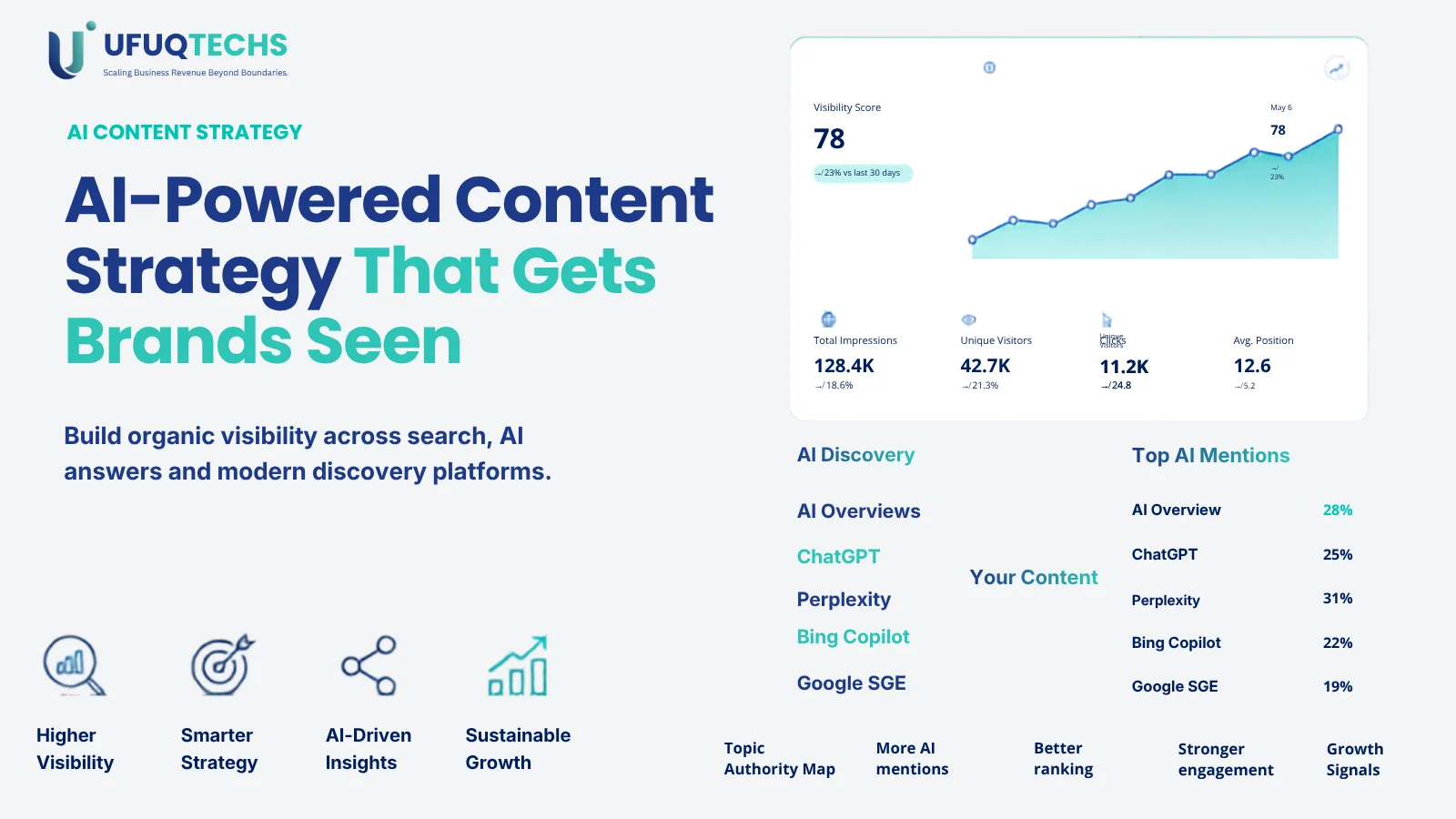
How AI-Powered Content Strategy Services Increase Organic Visibility for Brands
You've hired content writers. You've invested in SEO. You've published consistently. Yet your organic visibility is declining. The problem isn't your effort. It's your strategy.
A major shift is underway. Content consumption habits are evolving, and brands that fail to embrace AI-powered content strategies are falling behind. Research indicates that traditional digital marketing strategies are becoming saturated, with content merely aiming for higher rankings.
The industry is moving toward AI content strategy services—a new discipline that combines AI capabilities with human-led strategic oversight.
According to research, 40% of B2B marketers are already on the record for using generative AI . AI can help generate content ideas, create briefs, create first drafts, and summarize content.
However, "weak brand presence, too much content, and a focus on quantity over quality" remain major challenges . Winning organic visibility now demands net-new information, original data, and demonstrable expertise.
This guide shows you how AI-powered content strategy services increase organic visibility for brands. You'll learn what works, what doesn't, and how to build a strategy that actually delivers results.
The problem is simple: generic content strategies are being penalized. The solution is an AI-powered strategy with human oversight that creates content people actually want to read.
Why Traditional Content Strategies Are Failing
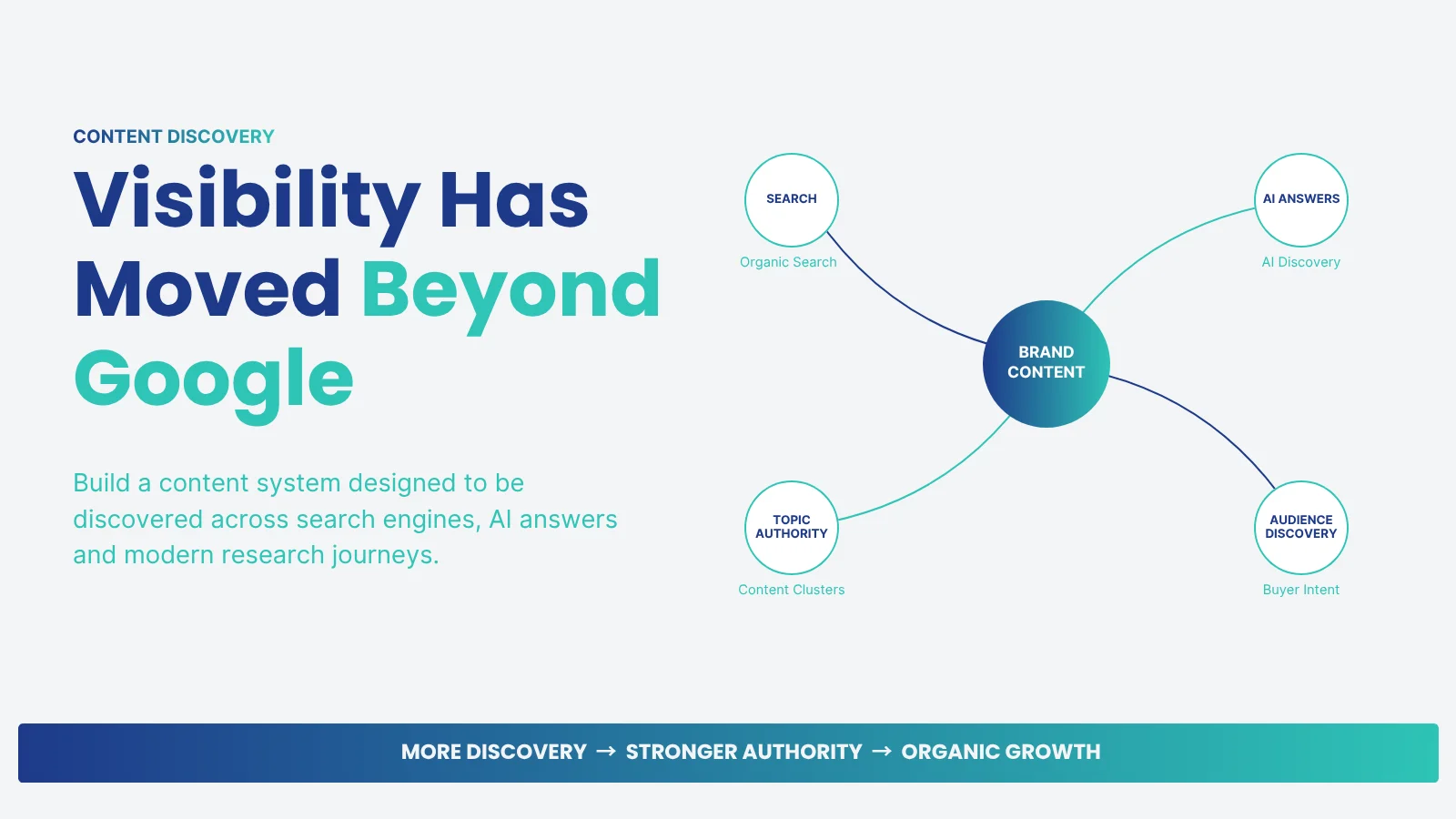
Three forces are reshaping content marketing.
The Shift in Search and Information Discovery
Content marketing is at an inflection point. AI tools have made it faster and cheaper to produce content at scale, but the resulting flood of material creates challenges on marketers' highest-earning channels.
Research from Accenture reveals that 52% of consumers are now using generative AI for product research and discovery—a figure that jumps to 64% among Gen Z.
Consumers are abandoning traditional search for AI-powered discovery. EY research shows that 42% of consumers are already using AI assistants, with 50% planning to use them this year . The result? Traditional SEO success no longer translates to AI-driven visibility.
Why Volume No Longer Equals Visibility
AI is rewriting the content quality bar. The flood of generic AI content has created new challenges. According to research, "brands risk sharing repetitive, shallow content with no unique perspective".
The volume trap is real: generic content drowns out original thinking, making it harder for brands to stand out.
The winning brands are publishing less, but smarter. Semantic relevance and topical depth now beat volume and frequency . Content that demonstrates expertise, original research, and unique insights is what AI platforms and search engines reward.
The 2026 Content Strategy Reality
| Factor | Traditional Strategy | AI-Powered Strategy |
| Content Production | Volume-driven, limited by team | Quality-driven, AI-assisted |
| Discovery | Google blue links | AI platforms, Google AI Overviews, chatbots |
| Success Metric | Traffic and rankings | Visibility in AI answers, revenue attribution |
| Differentiator | Publishing volume | Proprietary data, human expertise, credibility |
The AI-Powered Content Strategy Framework
Based on research and industry practice, here's what an effective AI content strategy looks like.
Pillar 1 — Strategic Content Blueprint
What it is: A data-driven plan that identifies what content to create, for whom, and why.
Why it matters: Research confirms that "content marketing generates 3x as many leads as outbound marketing while costing 62% less" . But only if the strategy is built around audience needs, not vanity metrics.
What a strategic blueprint includes:
- Audience insight — Understanding ideal customer profiles (ICPs), buyer journeys, and content consumption habits
- Topic and keyword clustering — Grouping related topics around core entities for semantic authority
- Content gap analysis — Identifying what competitors aren't covering
- Intent mapping — Matching content to informational, commercial, and transactional intents
The result: Content that actually reaches the right audience at the right stage of their journey—not content that exists for its own sake.
Pillar 2 — AI-Assisted Content Creation
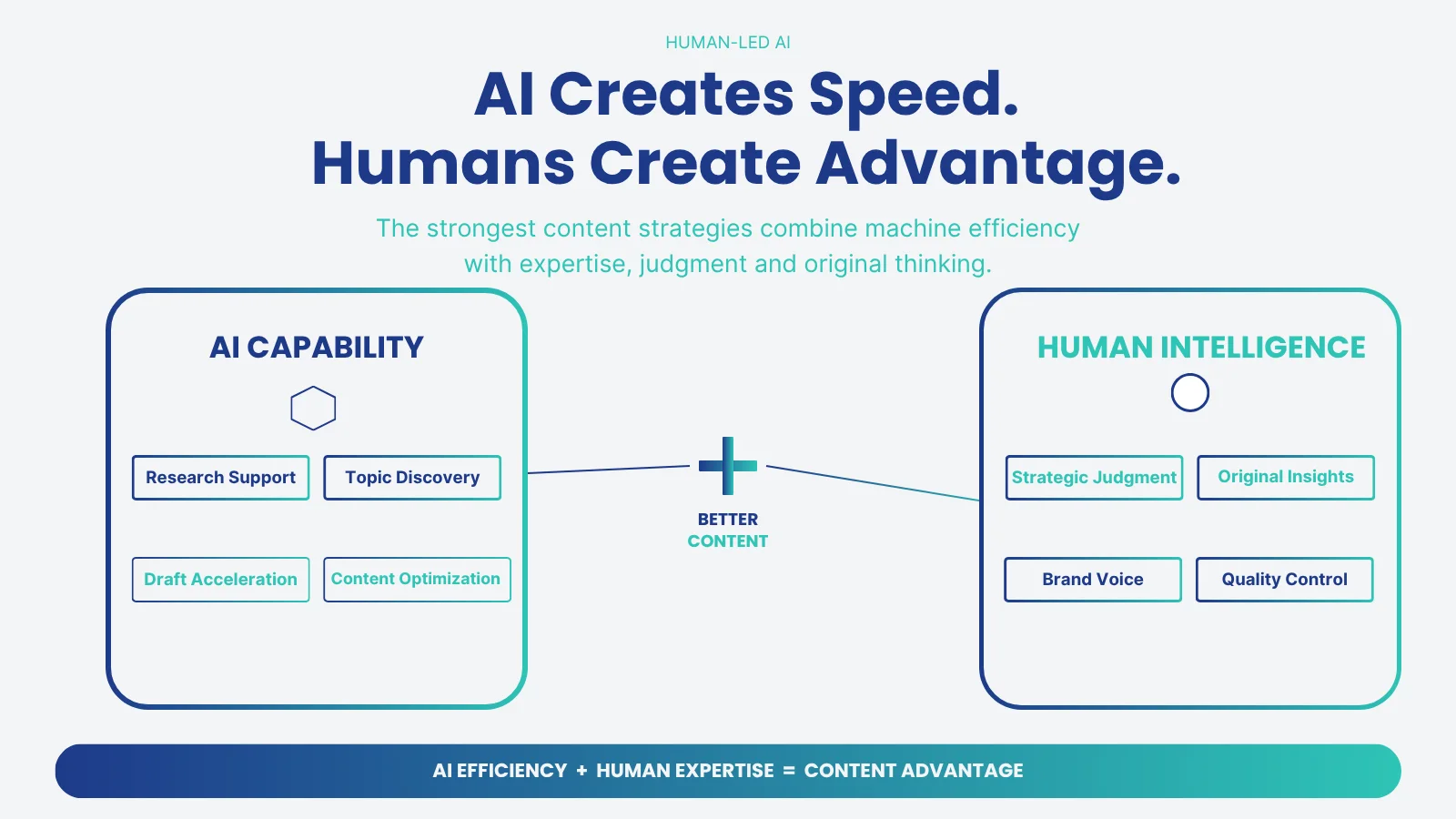
What it is: Using generative AI to accelerate content creation while maintaining human-led quality control.
Why it matters: Research confirms that AI helps "generate content ideas, create briefs, create first drafts, and summarize content" . However, AI "does produce mistakes, known as hallucinations. Human oversight is thus essential."
What AI-assisted creation looks like:
| Task | AI Role | Human Role |
| Ideation | Generate topic ideas, suggest angles | Strategic prioritization, audience alignment |
| Research | Gather data, identify sources | Expert interviews, original data collection |
| Creation | First drafts, outlines, structuring | Brand voice, storytelling, emotional connection |
| Optimization | Keyword suggestions, readability analysis | Strategic decisions, audience understanding |
The result: More content in less time, without sacrificing quality or brand voice.
Pillar 3 — AEO + GEO Visibility Optimization
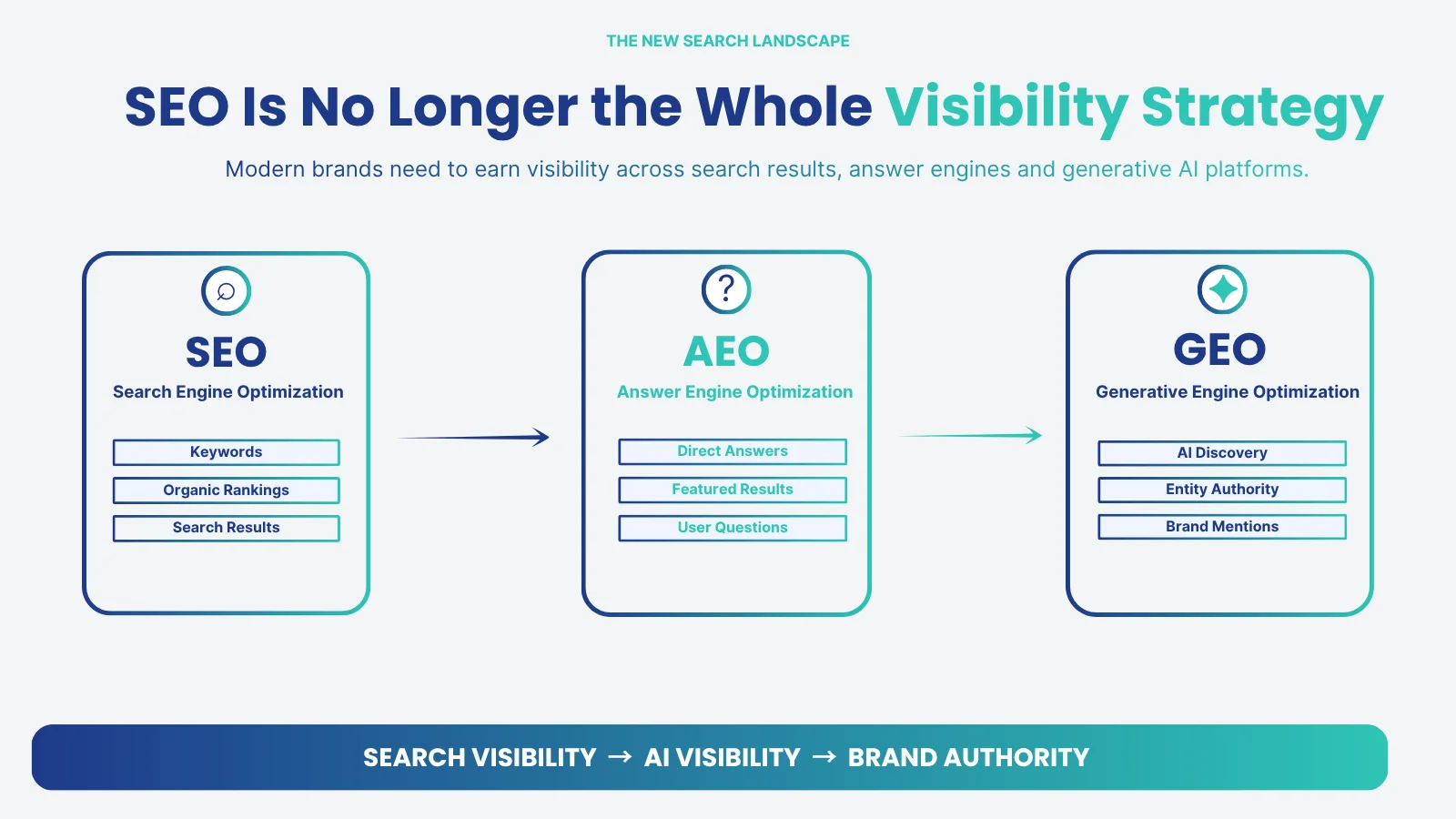
What it is: Optimizing content to appear in AI-generated answers and search results.
Why it matters: Research reveals that nearly half of all respondents (49%) discovered ChatGPT after seeing it used by friends, family, and social media . 45% of all respondents now use generative AI for research or learning.
Academic literature has explored the potential of AI to augment and scale content marketing by incorporating SEO strategies, optimizing content for AI-driven search, and enabling personalization.
What visibility optimization includes:
- Answer Engine Optimization (AEO) — Structuring content to directly answer user questions in featured snippets and AI responses
- Generative Engine Optimization (GEO) — Optimizing for ChatGPT, Gemini, Perplexity, and Copilot visibility
- Schema markup + structured data — Helping AI platforms understand your content's context
- Entity-based optimization — Building topical authority around entities, not just keywords
The result: Your brand appears where modern buyers actually search—not just in blue links.
Pillar 4 — Conversion-Centered Content'
What it is: Content designed to move readers from awareness to action.
Why it matters: Content marketing is most effective when it "targets niche audiences and speaks to customer pain points, desires, and motivations". Research confirms that content designed with conversion in mind "builds awareness, educates audiences, and leads to action."
What conversion-centered content includes:
- Clear value proposition — What the reader gains from engaging
- Strategic CTAs — Guiding readers to next steps
- Objection handling — Addressing hesitations directly
- Transformation framing — Showing the after-state, not just the process
The result: Content that doesn't just attract attention—it drives action.
Pillar 5 — Performance Measurement and Optimization
What it is: Tracking content performance against business outcomes and iterating based on data.
Why it matters: 31.4% of marketers report the biggest performance decline in organic search and SEO . Without measurement, you can't optimize.
What measurement includes:
| Metric Type | Examples | Why It Matters |
| Visibility | AI platform mentions, organic rank | Reaching the right audience |
| Engagement | Time on page, bounce rate, scroll depth | Content quality and relevance |
| Conversion | Leads, sign-ups, sales, revenue | Business impact |
| Brand Health | Share of voice, sentiment, recall | Long-term brand growth |
The result: Continuous improvement based on what actually works.
Common Content Strategy Mistakes (And How to Avoid Them)
Research identifies these mistakes that kill organic visibility:
| Mistake | Why It Fails | Better Approach |
| Producing content for search engines, not people | AI platforms and Google reward user-centric content | Create content that answers real questions and provides unique value |
| Publishing at high volume, low quality | Generic content is being penalized | Publish less, invest more in quality, data, and insight |
| Ignoring AI and LLM optimization | You're invisible where buyers actually search | Implement AEO and GEO strategies |
| Not building topic clusters | No depth or authority on any subject | Create interlinked content pillars around core entities |
| No human oversight of AI-generated content | Generic content with no unique perspective | Maintain human editing, brand voice, and expertise |
Your AI Content Strategy Evaluation Checklist
Use this checklist when evaluating content strategy services:
| Parameter | What to Check |
| Strategic Blueprint | Data-driven plan with audience insight and ICP understanding |
| AI-Assisted Creation | Human oversight of AI-generated content |
| AEO + GEO Optimization | Content optimized for AI platform discovery |
| Conversion-Centered | Content designed to drive action, not just traffic |
| Performance Measurement | Tracking visibility, engagement, conversion, and brand health |
| Topic Clustering | Building entity-based topical authority |
| Proprietary Data | Original research, surveys, unique insights |
FINAL THOUGHTS
The shift to AI-powered content strategy isn't optional. 40% of B2B marketers already use generative AI . 42% of consumers use AI assistants . 52% use AI for product research and discovery . The trend is accelerating.
Generic content strategies are failing. Research confirms that generic, AI-generated "book report" content is being penalized. Success belongs to brands that combine AI capabilities with human expertise, original data, and strategic thinking.The right AI-powered content strategy is a revenue engine. The wrong one is an expensive distraction.
FINAL SECTION — CALL TO ACTION
Ready to Build an AI-Powered Content Strategy That Drives Organic Visibility?
Stop creating content that nobody sees. Ufuqtech helps brands implement AI-powered content strategies that increase organic visibility, build authority, and generate revenue.
Here's what we deliver:
- Strategic blueprint — Data-driven content plan aligned with your ICP and business goals
- AI-assisted creation — Content that combines AI efficiency with human expertise and brand voice
- AEO + GEO optimization — Visibility across ChatGPT, Gemini, Perplexity, and Google AI Overviews
- Conversion-centered content — Content designed to move readers from awareness to action
- Performance measurement — Tracking visibility, engagement, conversion, and brand health
Still hesitant? You've seen content agencies that promise results and deliver nothing. We don't make promises we can't keep. We start with a discovery phase to understand your brand, audience, and goals. Then we build a strategy tailored to you.The best time to fix your content strategy was before AI changed search. The second-best time is now.
Visit: www.ufuqtech.com
Email: contact@ufuqtech.com
Schedule a free consultation and get an AI content strategy audit for your brand.