SEO
How AI SEO Services Help You Earn Organic AI Citations Across ChatGPT, Google AI Overviews & Perplexity
Search has changed forever. Ranking on Google's first page is no longer enough. Today, millions of users ask questions directly to ChatGPT, Google AI Overviews, Gemini, Claude, and Perplexity instead of clicking through ten blue links.
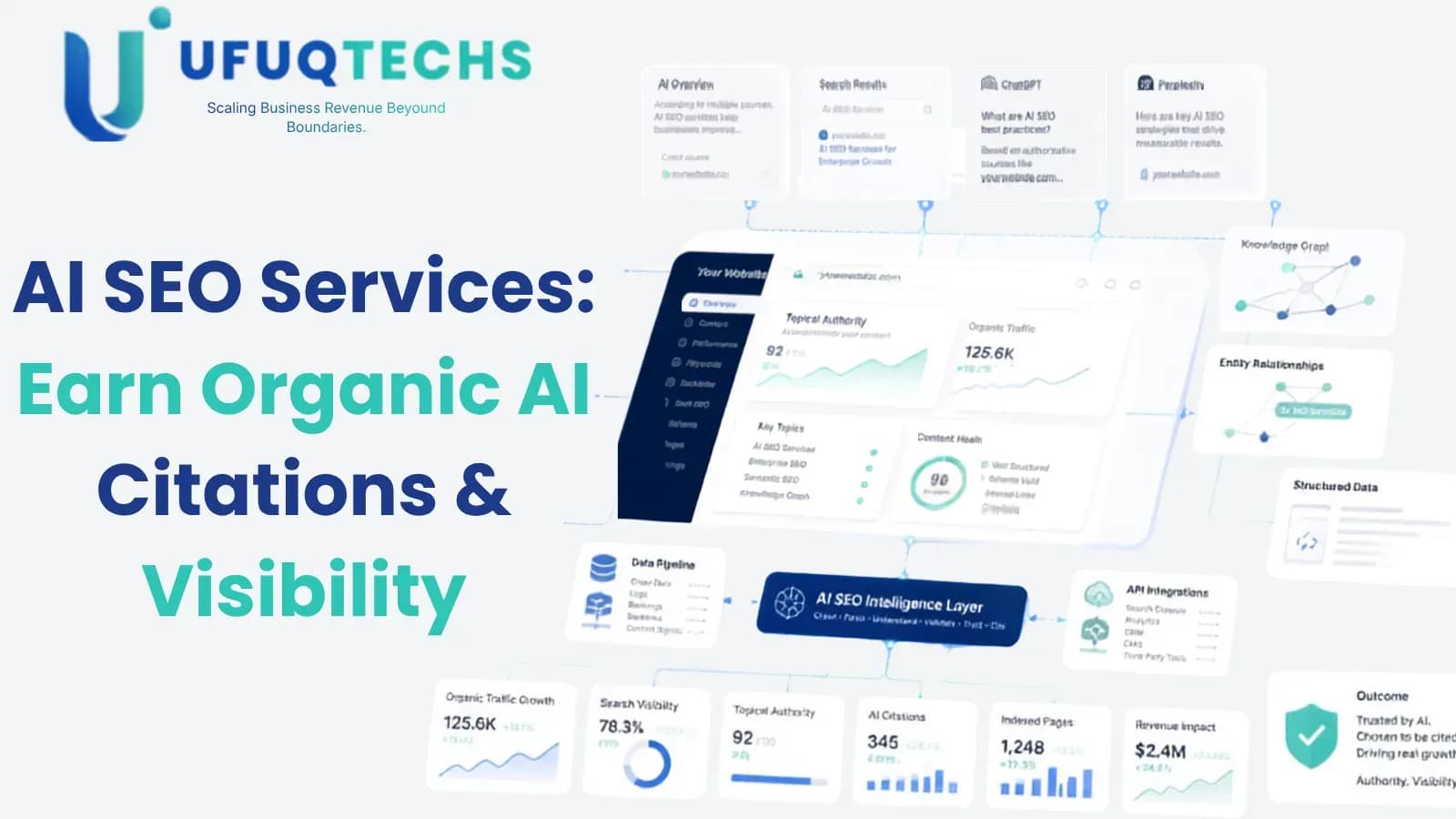
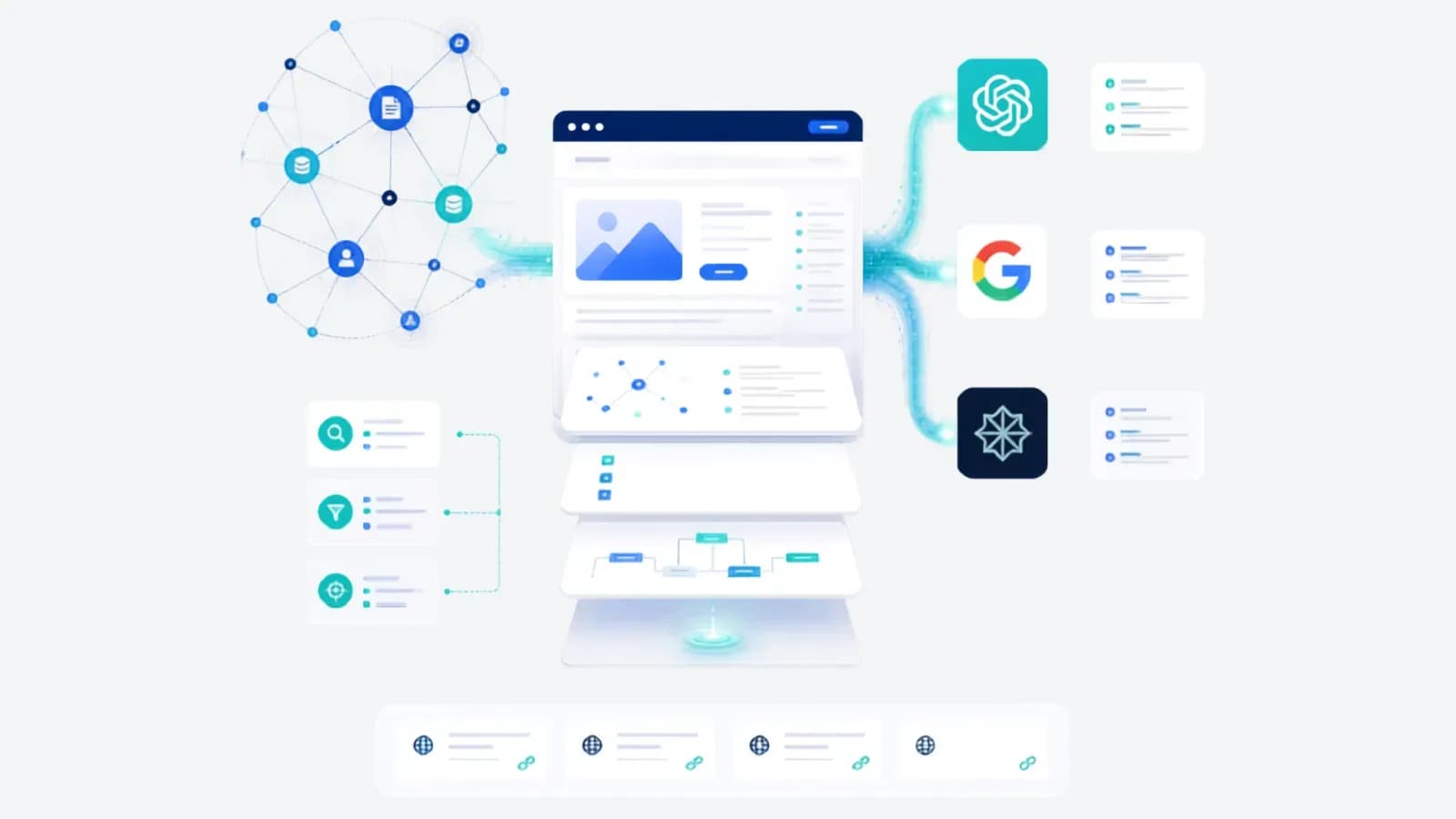
Search has changed forever. Ranking on Google's first page is no longer enough.Today, millions of users ask questions directly to ChatGPT, Google AI Overviews, Gemini, Claude, and Perplexity instead of clicking through ten blue links.
These AI search engines don't simply rank websites. They analyze entities. They understand topical authority. They compare trusted sources. Then they cite the websites they believe deserve to be referenced. This shift has created a new challenge for businesses.
If AI doesn't recognize your expertise, your website may never become part of the conversation—even if it ranks well in traditional search results.This is where AI SEO Services become essential.Rather than optimizing only for Google rankings, AI SEO focuses on making your business discoverable, understandable, and trustworthy across modern AI-powered search experiences.
In this guide, you'll learn:
- What AI SEO really means
- How AI search engines choose websites to cite
- The difference between SEO, AEO, and GEO
- Proven strategies to earn AI citations
- Common mistakes businesses make
- How to future-proof your organic visibility
Let's begin by understanding why AI search is rewriting the rules of SEO.
The Evolution of Search
Search has evolved through three major phases.
Era | Primary Goal | Ranking Method |
|---|---|---|
Traditional Search | Find web pages | Keywords & backlinks |
Semantic Search | Understand intent | Entities & context |
AI Search | Generate answers | Trust, authority & citations |
Today, AI search engines synthesize information instead of simply listing websites.Instead of asking, "Best AI SEO agency" Users ask, "How can I optimize my website to appear in ChatGPT responses? The AI reads dozens of trusted sources. It summarizes them. Then it cites only the most authoritative ones. That changes everything.
What Are AI SEO Services?
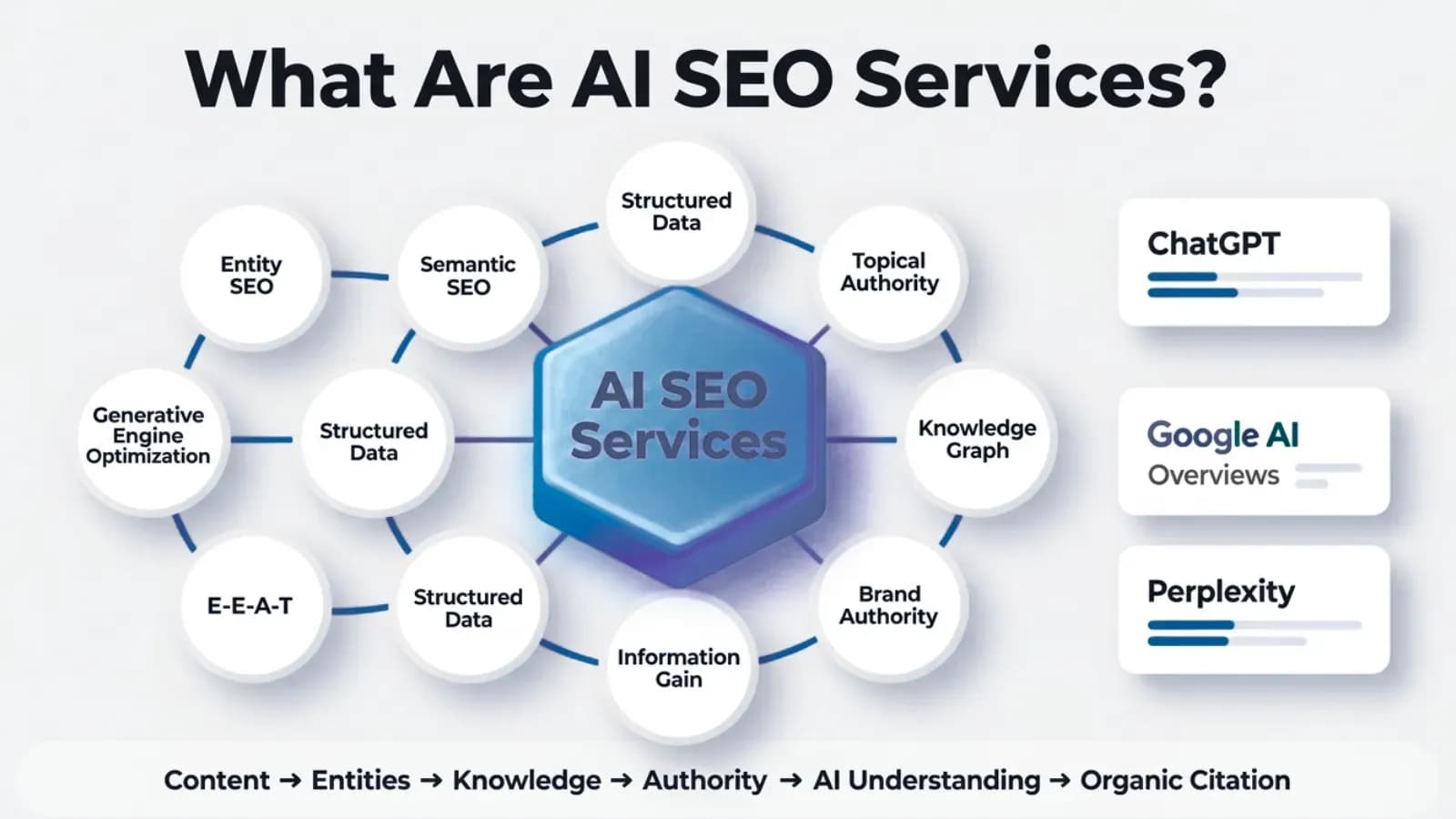
AI SEO Services are a modern search optimization framework designed to increase your visibility across AI-powered search engines.In simple words, AI SEO services are the process of building a structured content ecosystem where every page, entity, and topic is connected around user intent. This helps AI search engines understand your expertise, establish your authority, and cite your website as a trusted source in AI-generated answers.
Unlike traditional SEO, AI SEO helps machines understand:
- Who you are
- What your business specializes in
- Why your content is trustworthy
- Which topics you own
- Whether your website deserves citation
The objective isn't simply ranking. The objective is becoming the source AI trusts.
AI SEO Includes
- Entity SEO
- Semantic SEO
- Topical Authority
- Answer Engine Optimization (AEO)
- Generative Engine Optimization (GEO)
- Structured Data
- Knowledge Graph Optimization
- Information Gain Content
- EEAT Signals
- Brand Authority Development
Together, these components increase the probability that AI systems reference your website when generating answers.
Why AI Citations Matter
Organic traffic is changing. Users increasingly receive complete answers without visiting multiple websites. If your business becomes one of the cited sources inside AI-generated answers, your brand gains:
- Higher trust
- Increased visibility
- Better brand recall
- Qualified traffic
- Improved authority
- More inbound leads
Instead of competing for clicks alone, you're competing for citations. That's the next frontier of organic growth.
How AI Search Engines Choose Sources
Modern AI systems don't rely on a single ranking factor. They evaluate hundreds of quality signals before deciding which websites deserve inclusion. Some of the most important include:
1. Topical Authority
Does the website comprehensively cover a subject? Publishing one article about AI SEO isn't enough. Publishing 50 interconnected, high-quality articles creates authority.
2. Entity Relationships
AI understands concepts rather than isolated keywords. For example, AI SEO naturally connects with entities like:
- Google AI Overviews
- Chat GPT
- Gemini
- Claude
- Perplexity
- Schema Mark up
- Knowledge Graph
- Search Intent
- Semantic SEO
- EEAT
The richer these relationships are, the easier AI understands your expertise.
3. Information Gain
AI values original insights. If every article repeats the same information, none stands out.
High-performing content includes:
- Original frameworks
- Proprietary methodologies
- Case studies
- Industry experience
- First-hand expertise
- Unique research
This aligns directly with Google's emphasis on experience and helpful content.
4. Structured Data
Schema markup helps machines understand:
- Authors
- Organizations
- Services
- FAQs
- Reviews
- Articles
Without structured data, AI has less context about your content.
5. EEAT Signals
Google continues emphasizing:
- Experience
- Expertise
- Authoritativeness
- Trustworthiness
AI systems increasingly rely on these same quality indicators when selecting sources.
Traditional SEO vs AI SEO
Traditional SEO | AI SEO |
|---|---|
Focuses on rankings | Focuses on citations |
Keyword-first | Entity-first |
Backlink driven | Authority driven |
Search results | AI-generated answers |
Individual pages | Complete topic ecosystems |
Rankings | Trust signals |
CTR | Citation visibility |
This doesn't mean traditional SEO is dead. It means AI SEO builds on traditional SEO—not replaces it.
The Five Pillars of AI SEO
1. Entity SEO
Build clear relationships between your brand, services, people, products, and topics.
2. Semantic Search Optimization
Write naturally. Cover concepts instead of repeating keywords. Help AI understand context.
3. Topical Authority
Create complete topic clusters instead of isolated blog posts. One pillar page should support dozens of related articles.
4. AEO (Answer Engine Optimization)
Answer real user questions directly. Use:
- FAQs
- Definitions
- Lists
- Tables
- Comparisons
- Step-by-step guides
These formats increase eligibility for AI-generated answers.
5. GEO (Generative Engine Optimization)
Optimize specifically for AI platforms including:
- ChatGPT
- Google AI Overviews
- Gemini
- Claude
- Perplexity
This means producing content that is:
- Well-structured
- Factually accurate
- Entity-rich
- Comprehensive
- Original
- Easy to summarize
How to Build an AI SEO Strategy That Earns Organic AI Citations
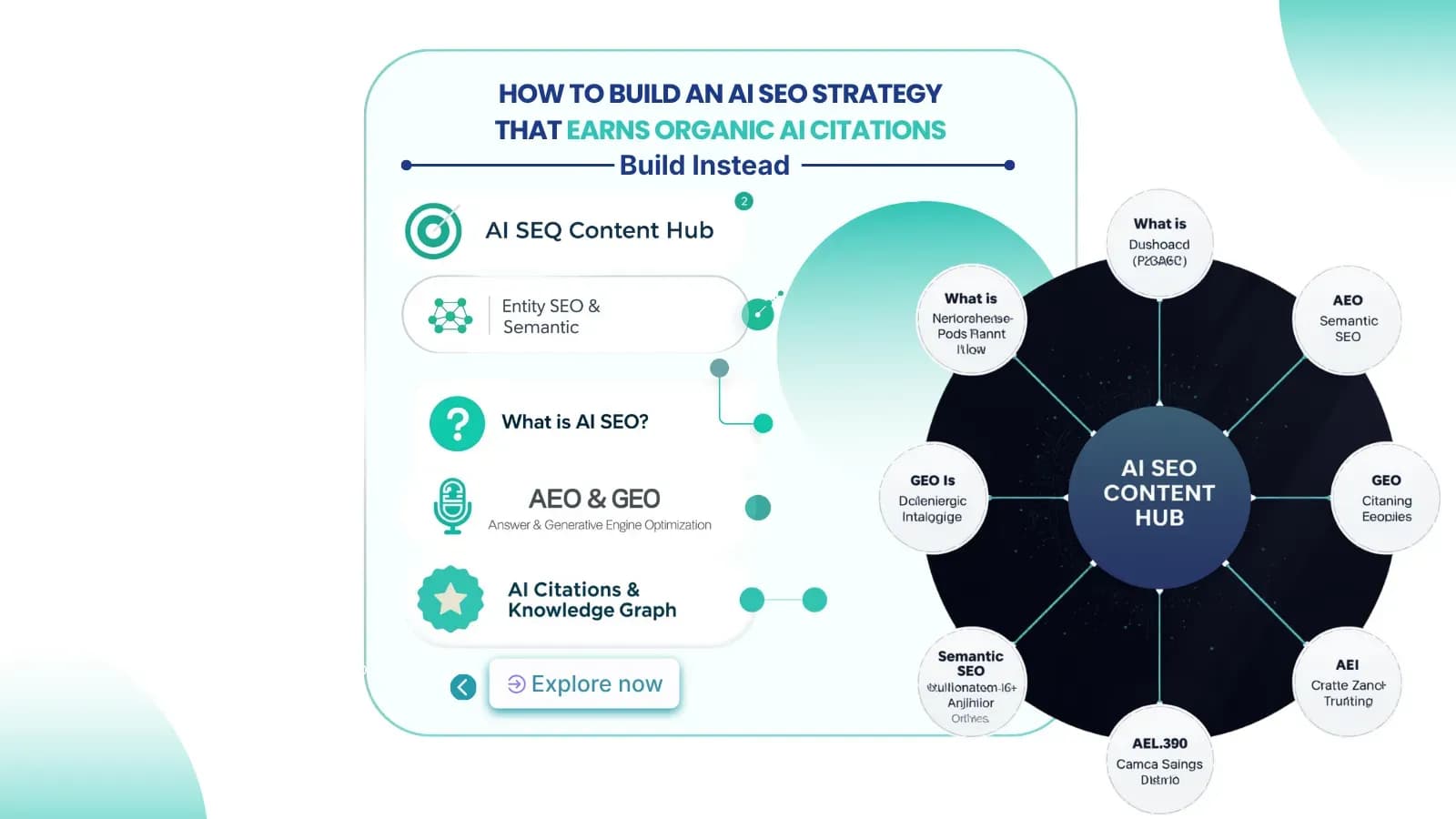
Publishing great content is no longer enough. AI search engines don't reward the loudest brand. They reward the clearest, most trustworthy, and most comprehensive source. If your goal is to earn citations from Chat GPT, Google AI Overviews, Gemini, Claude, and Perplexity, your strategy must be built around knowledge—not keywords alone.
Step 1: Build Topic Clusters Instead of Individual Blogs
Most businesses publish isolated articles. One week they write about SEO. The next week it's social media.
Then AI. Then branding. To AI search engines, this creates fragmented expertise. Instead, organize your content into topic clusters.
Example AI SEO Content Hub
AI SEO Services (Pillar)
- What is AI SEO?
- AI SEO vs Traditional SEO
- Entity SEO Explained
- Semantic SEO Guide
- Answer Engine Optimization
- Generative Engine Optimization
- Google AI Overviews SEO
- ChatGPT SEO Guide
- Perplexity SEO
- Claude SEO
- Gemini SEO
- Schema for AI Search
- Knowledge Graph Optimization
- AI Citation Optimization
- Future of Search
Each supporting article strengthens the authority of your pillar page. That's how topical authority is built.
Step 2: Focus on Entities, Not Keyword Density
Traditional SEO asked: How many times should I mention the keyword?
Modern AI asks: Does this website fully understand the topic? Instead of repeating AI SEO Services twenty times, naturally include related entities.
Example Entity Relationships
Primary Entity | Supporting Entities |
|---|---|
AI SEO | Semantic SEO, Entity SEO, AEO, GEO |
Google AI Overviews | Search Generative Experience, Featured Snippets, Knowledge Graph |
ChatGPT | OpenAI, LLMs, AI Citations, Conversational Search |
Schema Markup | JSON-LD, FAQ Schema, Organization Schema |
Topical Authority | Topic Clusters, Internal Linking, Content Hubs |
The stronger the relationships between entities, the easier it becomes for AI systems to understand your expertise
Step 3: Create Information Gain
One of the biggest weaknesses in AI SEO content today is repetition. Thousands of blogs explain:
- What AI SEO is
- Why AI search matters
- How AI is changing Google
Very few contribute something new.Information gain means adding insights readers can't easily find elsewhere.
Examples include:
- Original frameworks
- Industry research
- First-hand case studies
- Proprietary checklists
- Benchmark data
- Real implementation examples
This transforms your article from another opinion into a reference resource.
Step 4: Strengthen EEAT Signals
Google's EEAT framework is equally valuable for AI search. Before citing your content, AI systems look for signals that demonstrate credibility.
Build Experience
Show real projects, workflows, and implementation examples.
Demonstrate Expertise
Publish in-depth guides rather than surface-level summaries. Increase Authority Earn mentions from reputable websites and maintain consistent topical coverage.
Build Trust
Include:
- Author information
- Business details
- Privacy policy
- Contact page
- References to reliable sources
- Accurate, updated information
Trust is the foundation of AI citations.
Step 5: Optimize for Answer Engines (AEO)
People no longer search only with keywords.They ask questions.Instead of typing: AI SEO They ask: How do I get my website cited by ChatGPT? Your content should answer those questions directly. Use formats such as:
- Definitions
- Numbered steps
- Bullet lists
- Comparison tables
- FAQs
- Checklists
- "What is" sections
- "How to" guides
These structures make your content easier for AI systems to summarize and reference.
Step 6: Implement Structured Data
Structured data gives machines context beyond plain text. For AI SEO, consider implementing:
- Organization Schema
- Article Schema
- FAQ Schema
- Breadcrumb Schema
- Author Schema
- Service Schema
- WebSite Schema
Schema doesn't guarantee citations. But it helps AI interpret your content with greater accuracy.
AI SEO Implementation Checklist
Use this checklist before publishing any article.
- Cover the topic comprehensively.
- Include primary and supporting entities.
- Answer the main user questions.
- Add internal links to related content.
- Use descriptive headings.
- Break paragraphs into readable sections.
- Include original insights.
- Add comparison tables.
- Use FAQ sections.
- Implement structured data.
- Demonstrate EEAT.
- Keep information updated.
AI Search Optimization Statistics
The exact percentages vary by industry and continue to evolve, but current trends consistently point in one direction: AI-powered search is becoming a major discovery channel.
Trend | Why It Matters |
|---|---|
AI-generated answers are appearing for more informational searches | Fewer users rely solely on traditional blue-link results. |
Long-form, authoritative content is cited more frequently than thin articles | Comprehensive coverage improves the likelihood of being referenced. |
Pages with strong internal linking create better topical authority | AI can better understand relationships between topics. |
Structured data improves machine understanding of page context | Schema helps AI identify entities, services, authors, and FAQs. |
EEAT-focused content performs better in competitive niches | Demonstrated expertise and trust remain critical quality signals. |
Key takeaway: AI systems reward content that is accurate, comprehensive, well-structured, and trustworthy—not simply optimized for keywords.
Common AI SEO Mistakes
Many businesses are still optimizing for yesterday's search engines.
Avoid these mistakes:
- Publishing AI-generated content without expert review.
- Targeting only one keyword per page.
- Ignoring entity relationships.
- Writing thin 600-word articles.
- Building no internal links.
- Skipping structured data.
- Publishing without demonstrating expertise.
- Creating duplicate or generic content.
- Failing to update older articles.
- Chasing rankings instead of solving user problems.
The Future of Organic Search
Search is becoming conversational. Users increasingly expect direct, accurate answers instead of lists of links.
That means successful brands will:
- Own complete topics rather than isolated keywords.
- Build knowledge hubs instead of content calendars.
- Earn trust before expecting visibility.
- Become the source AI chooses to reference.
The businesses that invest in AI SEO today will be better positioned as AI-assisted search continues to grow.