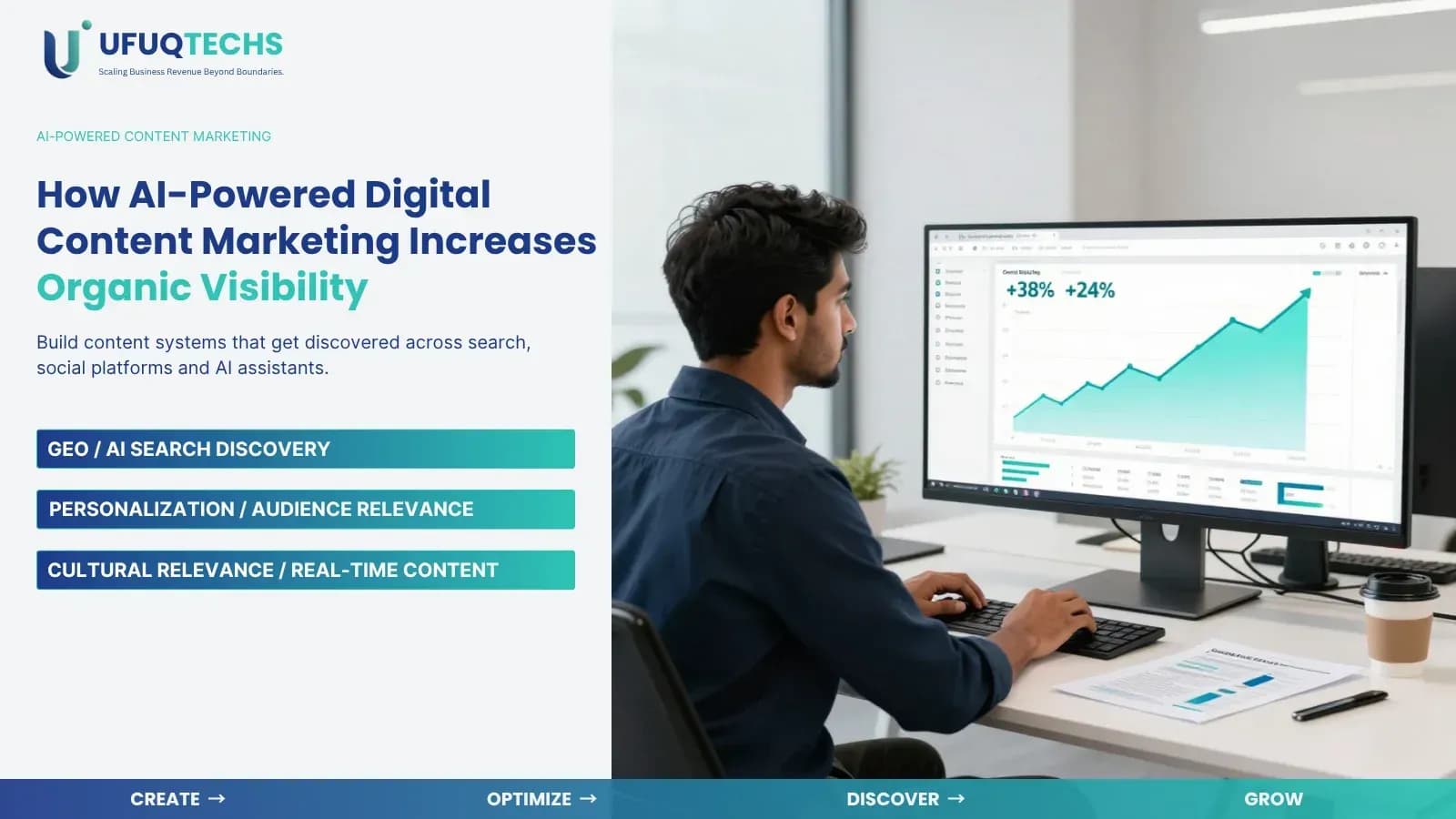
AI Content Marketing
How AI Content Marketing Can Increase Organic Visibility and Revenue for Indian Businesses
Your blog posts aren't ranking like they used to. Traffic is flat. Leads are down. AI isn't just changing content creation—it's rewriting the entire playbook for how buyers discover brands. Here's how to win.
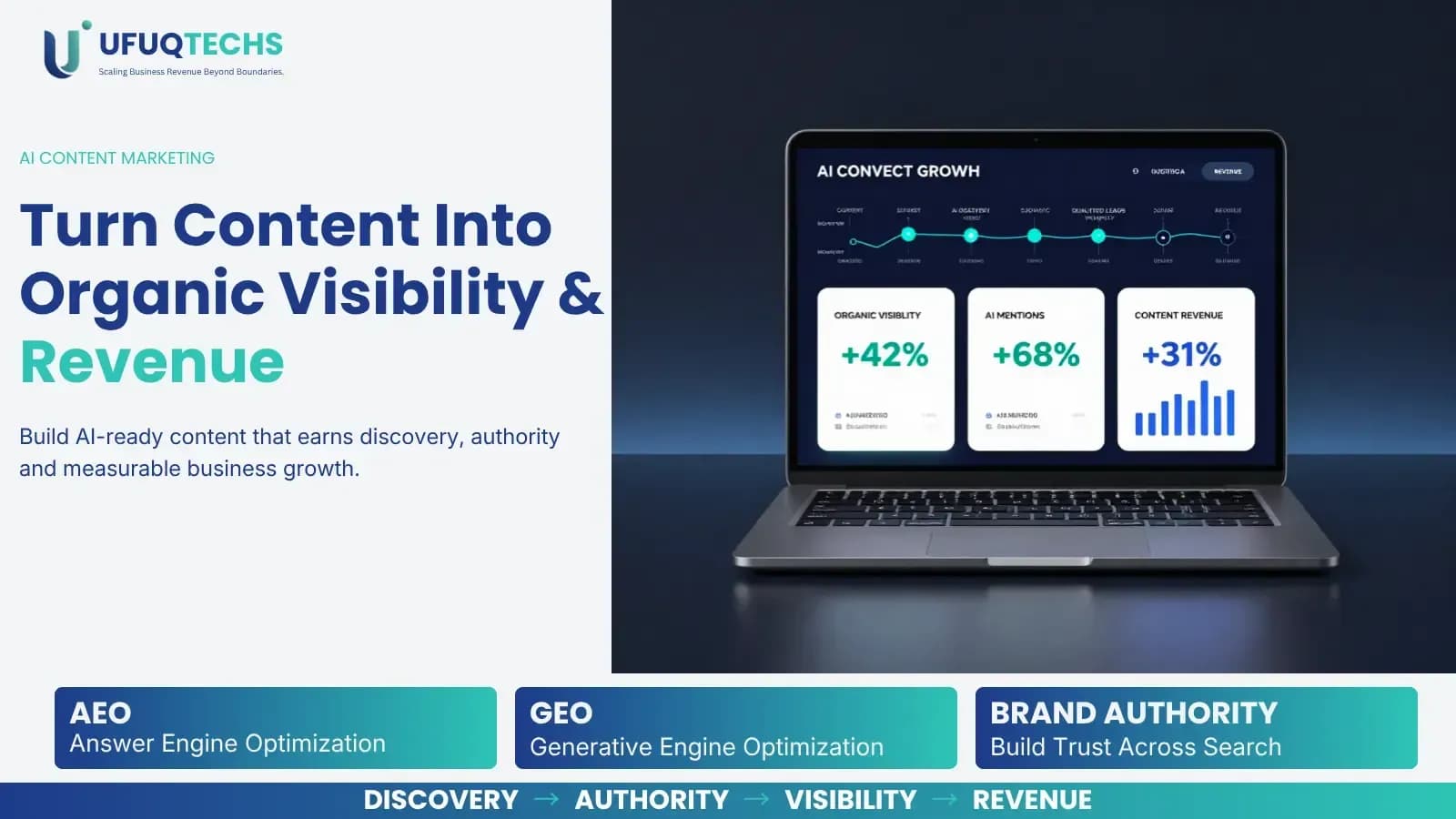
You're publishing more content than ever. Yet organic traffic is declining. Google's AI Overviews answer queries without clicks. ChatGPT and Perplexity summarize what you wrote without sending visitors. Your content strategy is working harder and delivering less.
The Institute for Studies in Industrial Development (ISID) research reveals Indian businesses are shifting from traditional SEO to AI-led content strategies. The Indian Institute of Science (IISc) confirms that organic visibility is no longer about keyword density—it's about brand authority and semantic relevance.
According to eMarketer data, content marketers report organic search and SEO as the biggest performance decline area (31.4%), ahead of website traffic (21.7%) and email marketing (21.4%) . Traditional SEO success no longer translates to AI-driven visibility—fewer than 10% of sources cited in ChatGPT, Gemini, and Copilot rank in the top 10 Google organic search results.
This guide shows you exactly how AI content marketing increases organic visibility and drives revenue for Indian businesses. You'll learn what's working, what's not, and how to build a strategy that actually delivers results.
The problem is simple: generic, AI-generated content is being penalized. Authority, first-hand experience, and demonstrable expertise—the pillars of Google's E-E-A-T framework—are the new currency of organic visibility. Here's what actually matters.
How AI Is Reshaping Content Marketing for Indian Businesses
The landscape has fundamentally changed. Here's what you need to know.
The New Reality of Content Marketing
Content marketing is at an inflection point. AI tools have made it faster and cheaper to produce content at scale, but the resulting flood of material creates challenges on marketers' highest-earning channels.
Factor | Traditional Reality | AI-Driven Reality |
Content Production | Limited by team size | Unlimited (75% of content professionals now use AI) |
Search Discovery | Google blue links | AI platforms, Google AI Overviews, chatbots |
Success Metric | Traffic and rankings | Brand visibility in AI answers, revenue attribution |
Competitive Advantage | Publishing volume | Proprietary data, human expertise, credibility |
Why Traditional SEO No Longer Works
Three forces are reshaping the future of content:
- Content explosion. AI has flooded the internet with generic, AI-generated content. Easy-to-answer queries get auto-summarized, pushing average content into obscurity.
- Quality threshold increase. AI models effortlessly produce summaries. Winning organic visibility now demands net-new information—original data, fresh insights, or novel angles.
- Reduced friction. AI reduces friction for users accessing content. Brand mentions and reputation increasingly influence AI-powered answers, driving visibility more than traditional backlinks.
Click-through rates on search queries are declining. Seer Interactive's analysis found that queries without AI Overviews dropped from 2.74% in June 2024 to 1.62% in September 2025; queries with AI Overviews dropped from 1.76% to 1.01% in the same period.
For content marketers relying on SEO-driven traffic, this represents a significant decline in their primary distribution channel.
The 5 Pillars of AI Content Marketing That Drive Revenue
Based on research, case studies, and industry practice, these five pillars represent what actually works.
1. AI Visibility Optimization (AEO + GEO)
Search is no longer limited to blue links. Consumers are discovering brands through AI-generated answers, recommendations, and summaries According to the CXL research, traditional SEO is gone—fighting for keywords and backlinks isn't enough anymore. It's about "Search Everywhere Optimization".
What to implement:
- Answer Engine Optimization (AEO): Structure content to directly answer user questions in featured snippets and AI responses.
- Generative Engine Optimization (GEO): Optimize for ChatGPT, Gemini, Perplexity, and Copilot visibility.
- Schema markup + structured data: Only ~30% of websites implement this well, yet it's one of the most overlooked ranking levers.
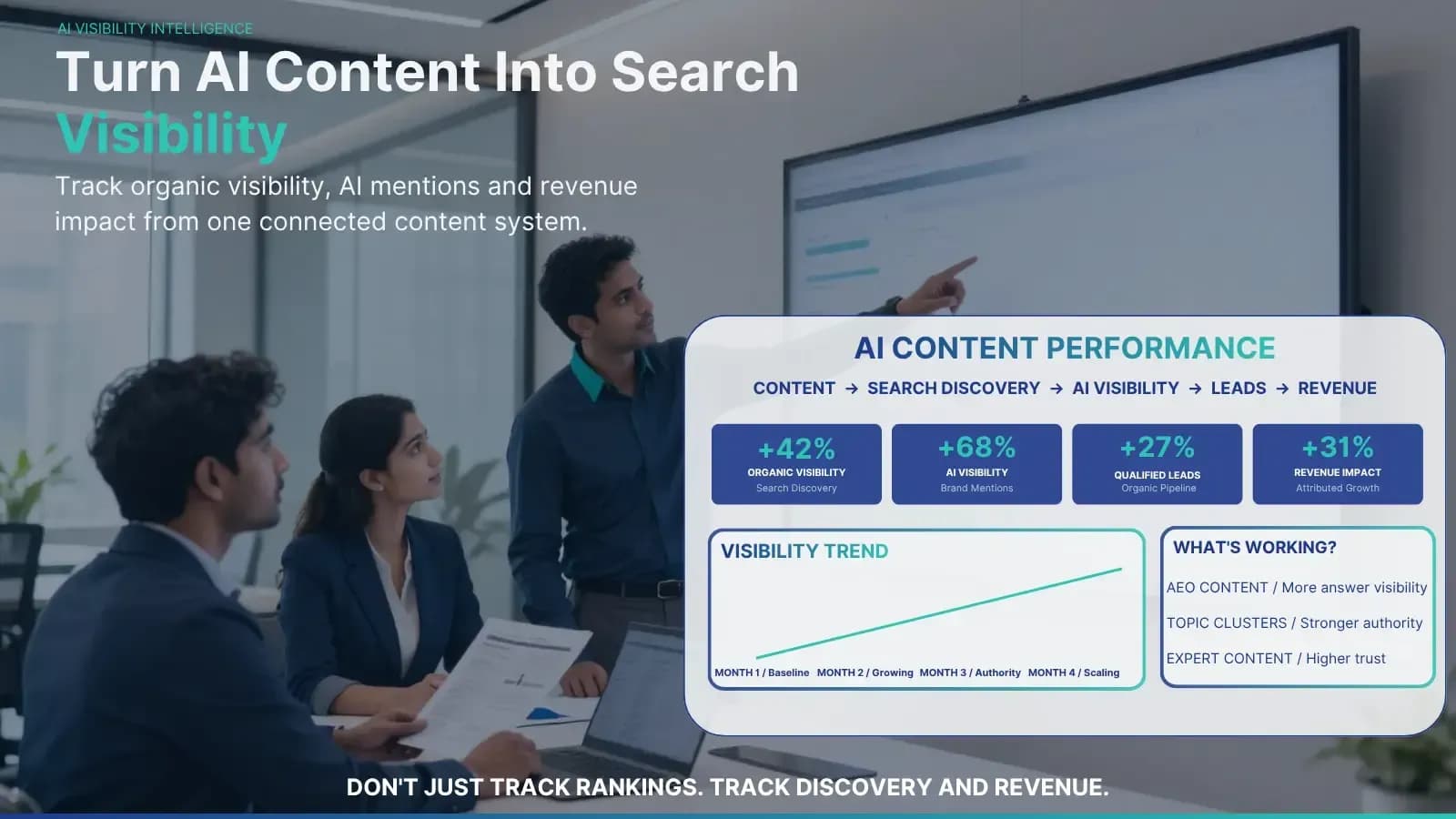
Brands that lead AI search visibility hold a significant advantage. Philips Machine Tools India doubled AI bot visits from 12.7k to 24.1k monthly and tripled AI-driven leads from 7 to 23 per month by implementing GEO strategies.
2. Proprietary Data and Original Research
Generic, AI-generated "book report" content is being penalized. AI models prioritize brands that consistently deliver high-value, accurate content. Information gain—the unique value provided beyond what already exists—is your new competitive advantage.
What to implement:
- Market surveys and original research reports
- Unique datasets and customer intelligence studies
- Expert interviews and thought leadership pieces
- Industry benchmarks and proprietary analytics
Smartling's case study proves the power of this approach. After a strategic pivot to AI-optimized content with human subject matter expert interviews, they achieved a 118% increase in organic blog traffic and a 31,250% jump in blog conversions—generating an estimated $3.7 million in new sales pipeline.
3. Brand Authority and Credibility
AI doesn't just count links—it weighs contextual mentions and citations from credible sources. This "surround sound SEO" strategy means actively managing your brand's visibility across influential industry platforms and niche communities.
What to implement:
- Earn mentions in reputable industry publications
- Build citations across authoritative platforms
- Develop thought leadership content that gets referenced
- Leverage expert contributors and industry voices
The Indian SEO industry is recognizing this shift. SEO veteran Jitendra Vaswani recently acquired Maxzob.com, a content marketing agency built on human expertise, journalistic sourcing, and genuine subject matter depth.
As Vaswani stated, "I have watched hundreds of agencies flood the internet with soulless, AI-spun content, and I have watched Google, and now LLMs, quietly demote them. Human expertise, journalistic sourcing, and genuine subject matter depth still win".
4. Content Clustering and Semantic Relevance
The best brands are publishing less, but smarter. Semantic relevance and topical depth now beat volume and frequency . Traditional keyword-based strategies are being replaced by entity-based optimization that signals topic authority to AI algorithms.
What to implement:
- Build topic clusters around core entities and subjects
- Create interlinked content pillars that demonstrate deep expertise
- Use structured data to establish entity relationships
- Focus on topical authority rather than keyword volume
Content clustering works because AI models understand context. When you publish 20 interlinked articles on a topic, AI models recognize you as a category authority—not just someone who wrote one good article.
5. Human-Led Creative Strategy with AI Efficiency
AI excels at data-intensive tasks: keyword clustering, competitor analysis, performance tracking, first-draft generation. Humans excel at strategic decisions, brand voice refinement, and creative storytelling that drives emotional connection and conversion.
What to implement:
Task | AI Role | Human Role |
Research | Keyword clustering, competitor analysis, topic discovery | Strategic prioritization, audience insight |
Creation | First draft generation, content structuring, SEO optimization | Brand voice, creative storytelling, emotional connection |
Optimization | Performance tracking, A/B testing, data analysis | Strategic decisions, audience understanding |
Distribution | Personalization, scheduling, automation | Channel selection, relationship building |
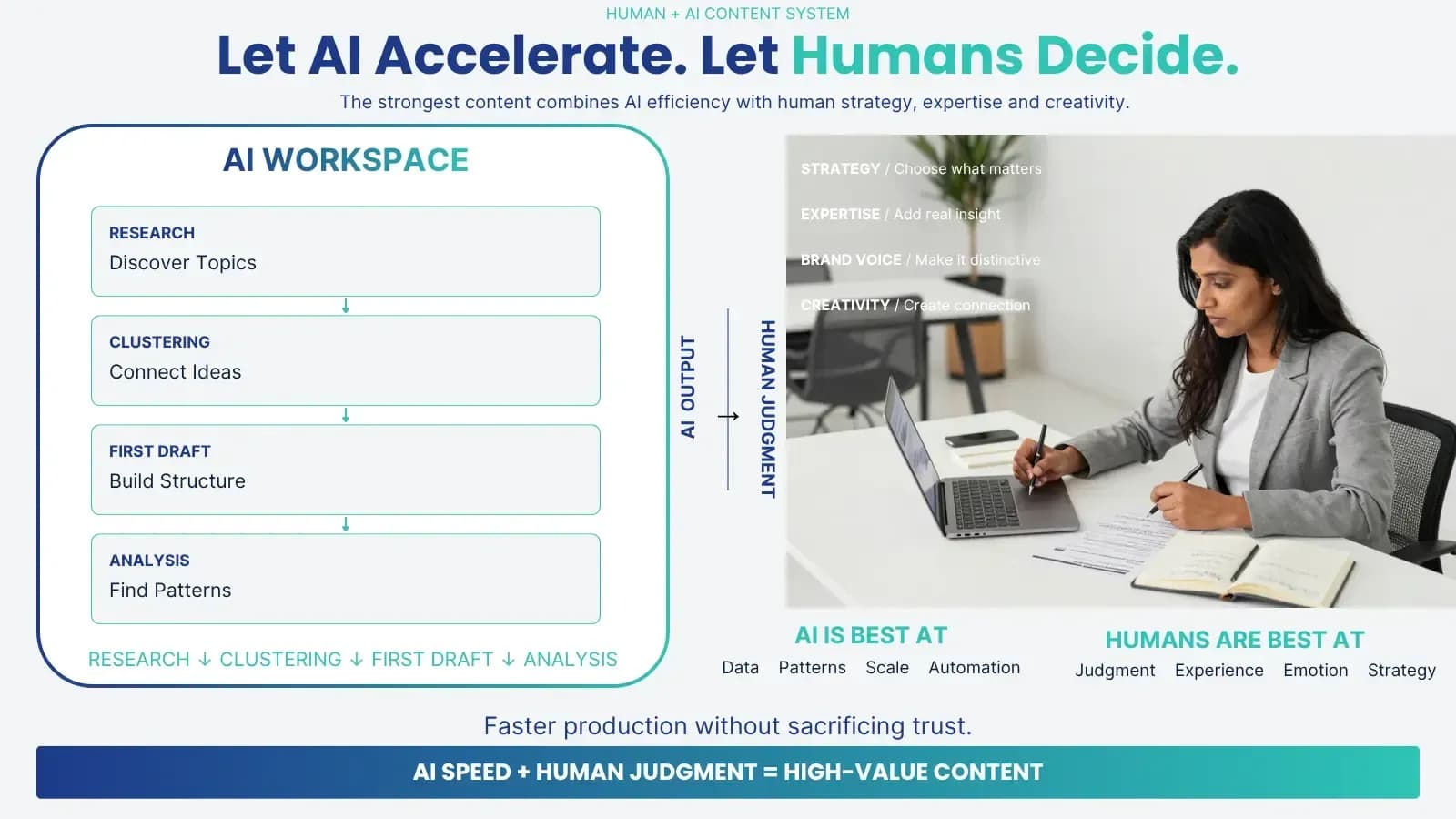
AIO (AI-Optimized) content strategies represent the evolution beyond simple AI content generation.
AI marketing reached $47.32 billion in 2025, representing massive investment in tools that power sophisticated content strategies.
However, 77% of marketers report that AI helps personalize content—but only when combined with human strategic oversight.
Red Flags That Should End the Conversation
These red flags indicate an AI content marketing strategy destined for failure:
Red Flag | Why It Matters |
Pure AI-generated content with no human editing | Algorithms detect and demote generic output; human insight is critical |
No measurable revenue attribution | If you can't track organic revenue, you can't prove ROI |
Chasing keywords instead of topics | Semantic relevance and entity optimization replace keyword density |
No visibility into AI platforms | You can't optimize what you can't measure |
Generic content that could apply to any business | Original data and unique insights are non-negotiable |
No answer engine optimization | AEO is now essential for AI-driven discovery |
No structured data implementation | Schema markup remains a critical ranking lever |
Your AI Content Marketing Evaluation Checklist
Use this checklist when evaluating your AI content marketing strategy:
Parameter | What to Check | Status |
AEO/GEO Strategy | Content structured for AI platform discovery and answer engines | ☐ |
Proprietary Data | Original research, surveys, unique insights created | ☐ |
Brand Authority | Mentions, citations, thought leadership presence across platforms | ☐ |
Content Clustering | Topic clusters built around entities, not just keywords | ☐ |
Human Oversight | Expert review, brand voice maintenance, creative strategy | ☐ |
Revenue Attribution | Organic traffic tied to revenue outcomes, not vanity metrics | ☐ |
AI Visibility Audits | Regular monitoring of how AI platforms represent your brand | ☐ |
Schema Implementation | Structured data deployed for entity optimization | ☐ |
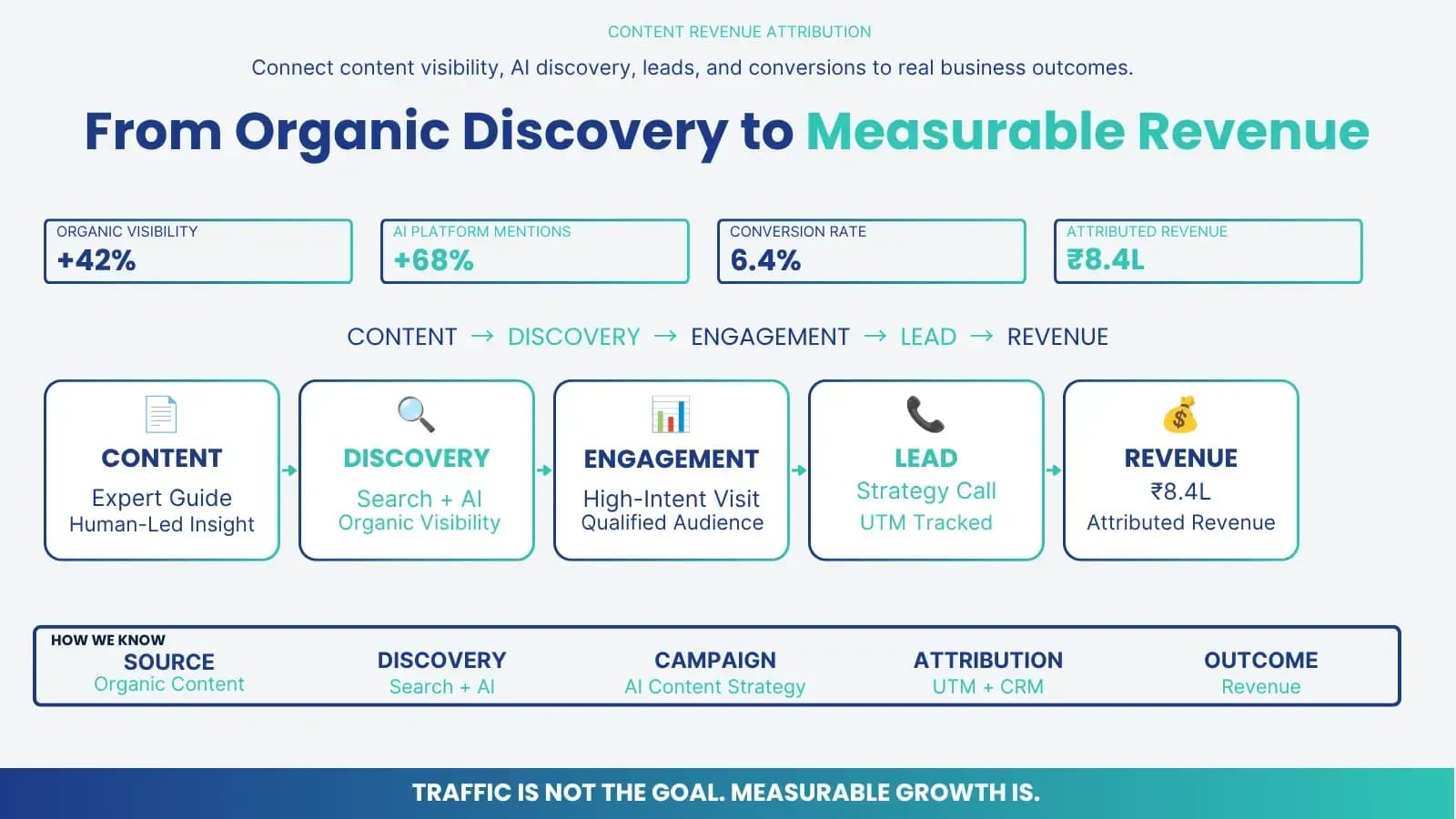
FINAL THOUGHTS
The shift from traditional SEO to AI-driven content marketing isn't coming—it's already here.Click-through rates are declining. Queries with and without AI Overviews both saw CTR drops over the past year .
Key research insights:
- Click-through rates are declining. Queries with and without AI Overviews both saw CTR drops over the past year.
- AI platform visibility doesn't mirror Google rankings. Fewer than 10% of sources cited in AI answers rank in Google's top 10.
- Performance is the primary concern. 31.4% of marketers report the biggest performance decline in organic search and SEO.
- Email and SEO remain the highest ROI channels. 28.0% identify email as delivering the highest ROI, followed by SEO at 26.1%.
The right AI content marketing strategy is a revenue engine. The wrong one is an expensive distraction.
The future of content marketing is hybrid. Not pure AI. Not a pure human. Strategic integration that leverages the best of both.
Ready to Build an AI Content Marketing Strategy That Drives Revenue?
Stop publishing content that doesn't convert. Ufuqtech helps Indian businesses implement AI-optimized content strategies that increase organic visibility, build brand authority, and generate measurable revenue.
Here's what we deliver:
- AEO + GEO optimization: Ensure your brand is visible across ChatGPT, Gemini, Perplexity, and Google AI Overviews
- Proprietary data strategy: Create original research that AI models cite
- Content clustering + topical authority: Build entity-based content that demonstrates deep expertise
- Revenue attribution: Track organic content performance to actual business outcomes
- Human-led creative strategy: Combine AI efficiency with human insight for content that actually converts
Still hesitant? You've seen generic AI content fail to deliver results. We don't produce generic content. We build strategic, human-centered content optimized for AI discovery. The best time to fix your content strategy was before AI changed search. The second-best time is now.
Visit: www.ufuqtech.com
Email: contact@ufuqtech.com
Schedule a free consultation and get an AI visibility audit of your current content strategy.